

Global Business Poll:
Powering Up
Business perspectives on electrification across 18 countries
 Australia
 Brazil
 China
China Colombia
 France
 Germany
 India
India Indonesia
 Japan
Japan Kenya
Kenya Nigeria
 Philippines
 Poland
 South Africa
 South Korea
 Turkiye
 UK
UK US
USGlobal Business Attitudes 2026
Executives back clean electrification amid fossil fuel volatility
Business leaders overwhelmingly support a rapid transition to electrified economies powered predominantly by renewable electricity.
As geopolitical tensions continue and governments remain focussed on strengthening economic resilience the message from business is clear: clean electrification has a central role to play in a long-term strategy for energy security, competitiveness and economic growth.
The polling data indicates that:
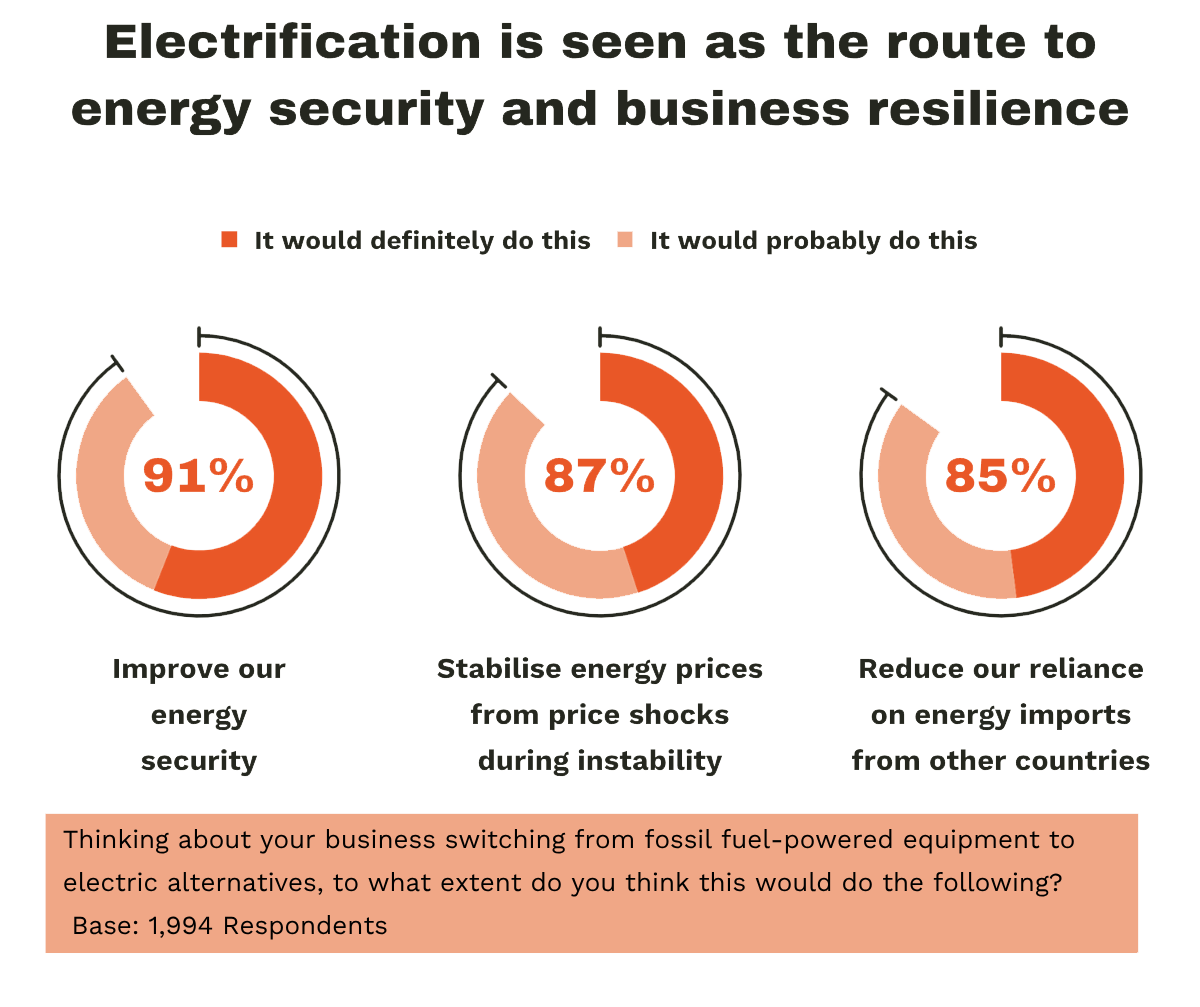
- Geopolitics accelerating electrification: 91% of business leaders say electrification would improve energy security, while 79% say geopolitical instability has made their own business shift to electrification more urgent.
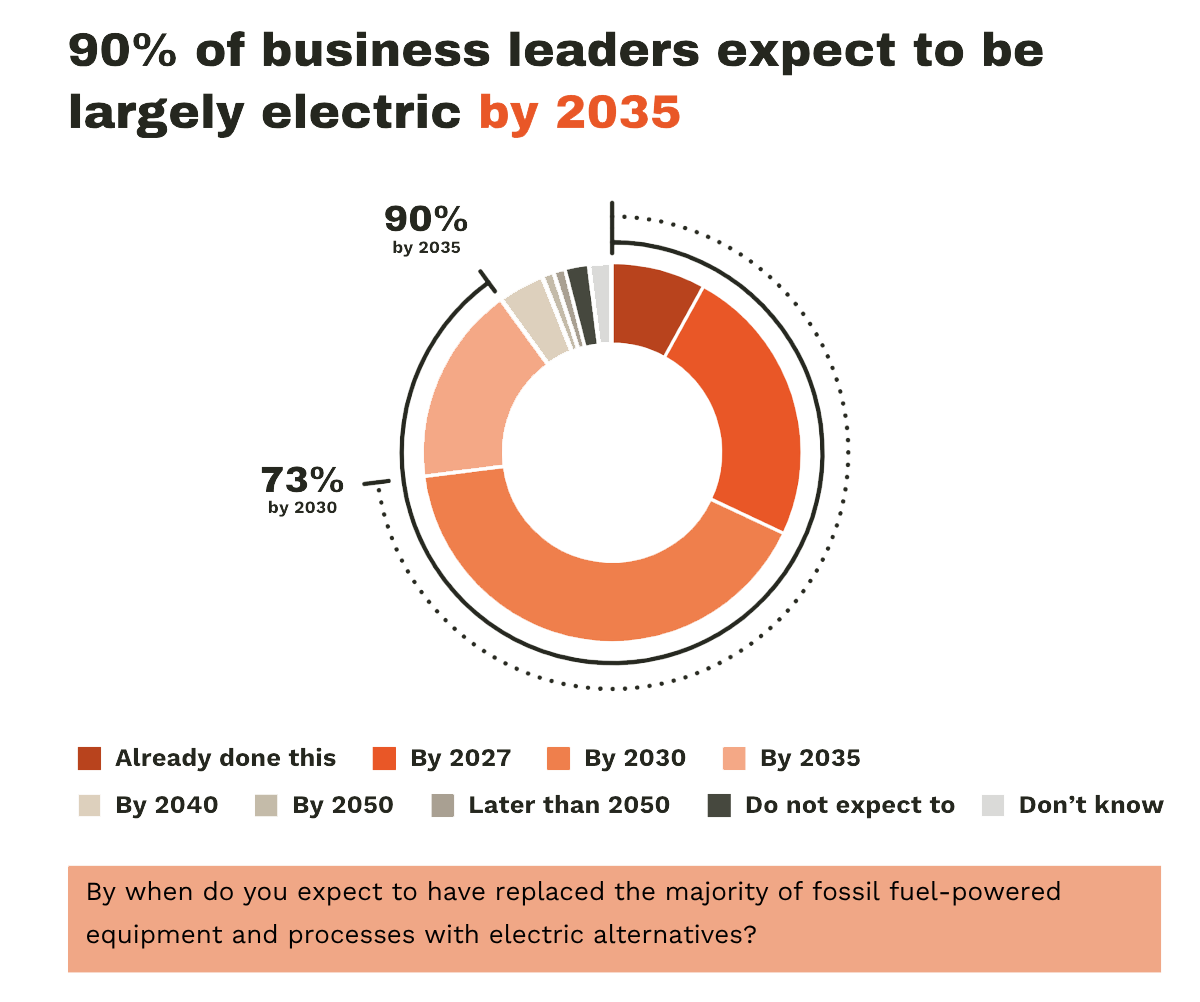
- Businesses want to electrify, fast. 90% of businesses expect to be largely electrified by 2035, with 73% expecting to be largely electrified by 2030.
- Competitiveness and growth: 88% say electrification is likely to improve business competitiveness, with 84% citing lower long-term operating costs. In addition, 90% say a renewables-based electricity system is likely to boost economic growth.
- Renewables over fossil fuels: Globally 82% want their country powered mainly by renewables, with 63% wanting their governments to shift away from fossil fuels by 2035.
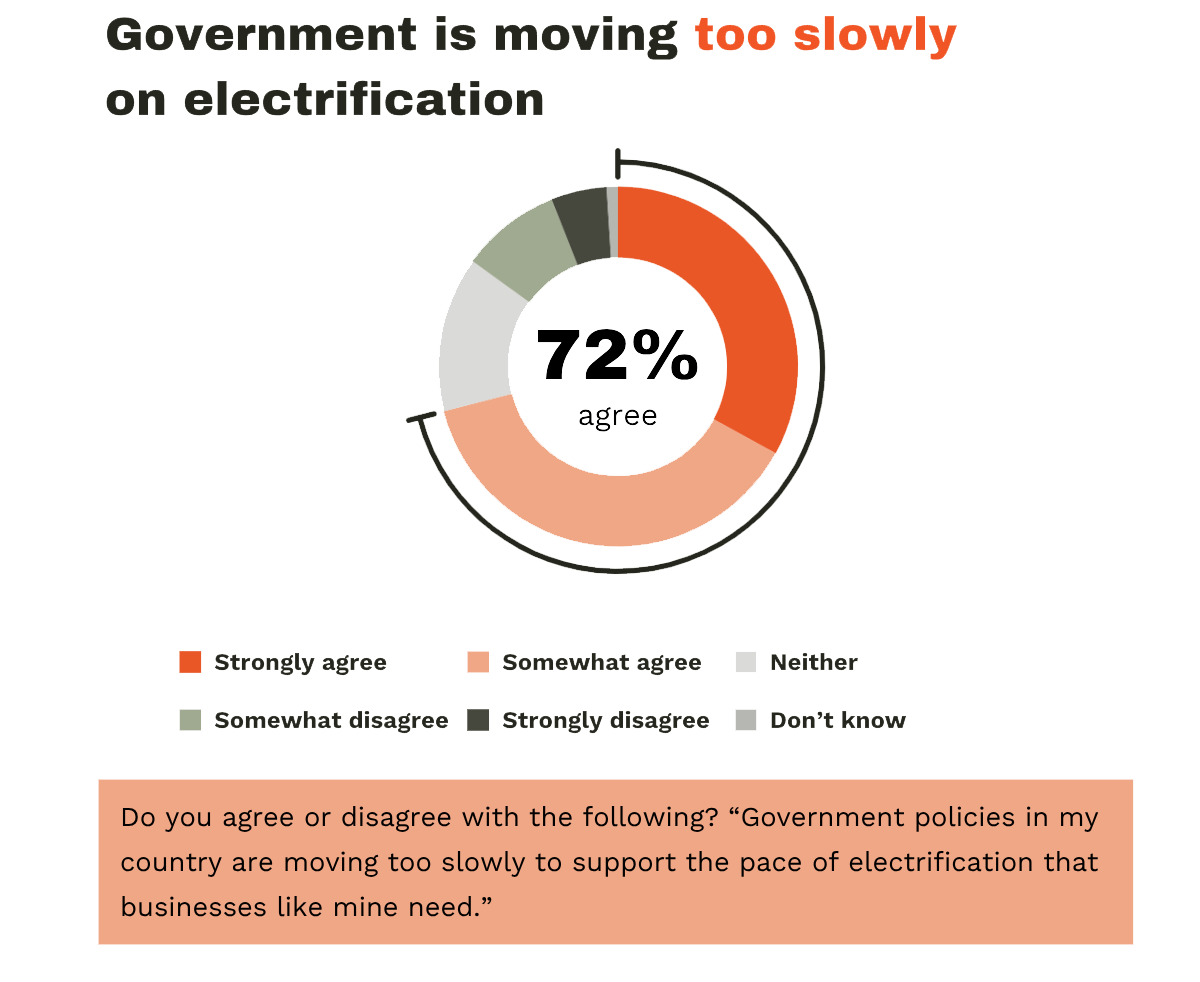
- Policy barriers slowing electrification: 72% say electrification policy is too slow, and 62% would consider relocating operations without sufficient government support.
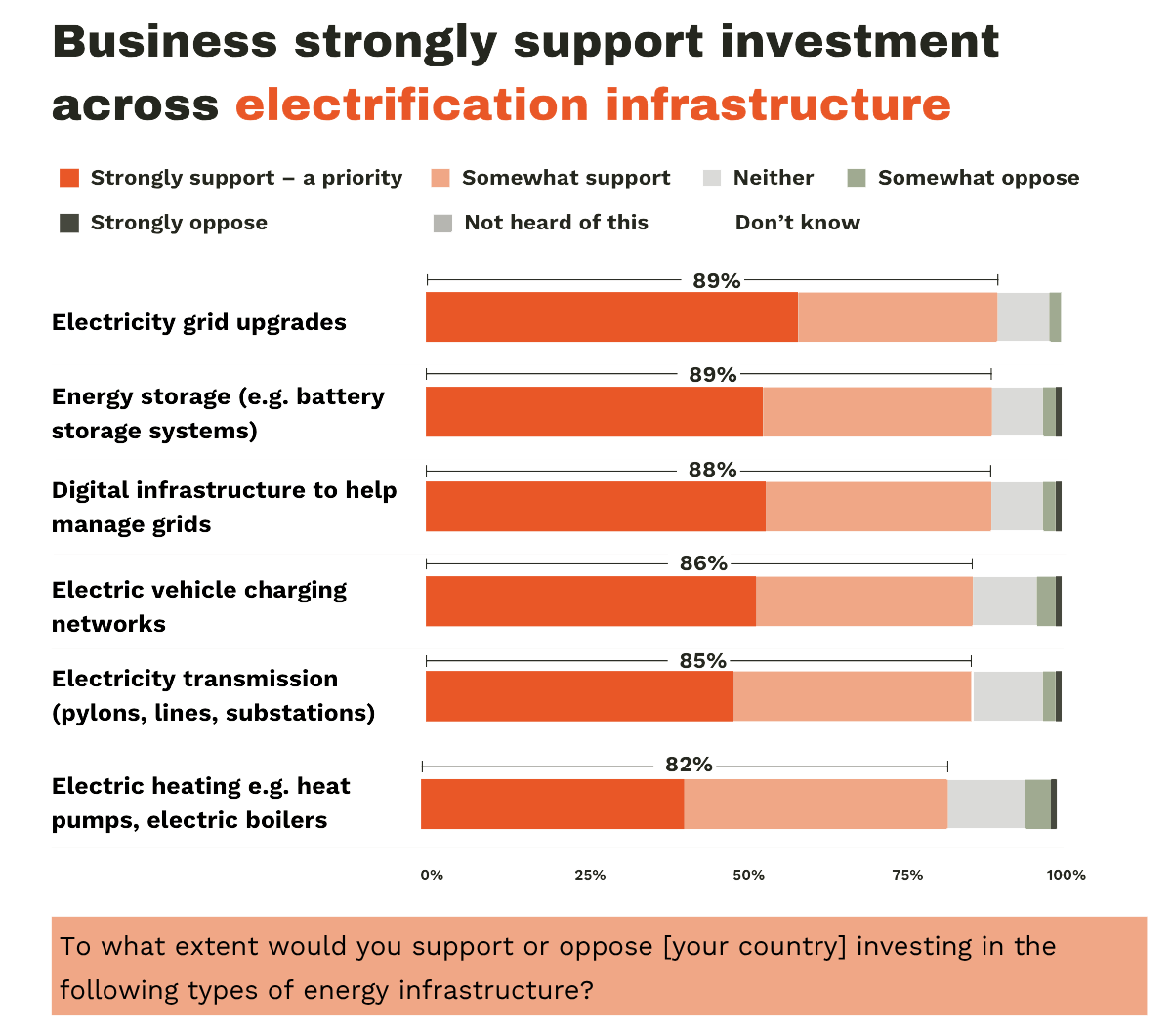
- Grids are key: Expanding and future-proofing electricity grids tops business priorities for accelerating electrification, with 89% supporting upgrades.

Governments and infrastructure are not keeping pace
Polling reveals that geopolitical instability is accelerating the business case for clean electrification, while power systems, grids, and policy frameworks are moving too slowly. The central challenge is no longer whether businesses want to electrify transport, buildings, and industry, but whether governments and infrastructure can meet demand. Governments that can support the rapid expansion of electrification powered mainly by renewables will be better positioned to capture the economic, energy security, and strategic advantages it offers.
Business demand is rising
- Executives strongly believe that switching from fossil fuel-powered equipment to electric alternatives (such as electric vehicles, heat pumps and electrified industrial processes) would stabilise energy prices against shocks during instability (87%).
- Four in ten companies have already invested in on-site renewable energy generation (e.g. rooftop solar, on-site wind and/or battery storage) to provide electricity for their operations (40%).
- 77% say their business should prioritise replacing fossil fuel systems with electric alternatives in the next decade.
- 84% say electrification would reduce long-term operating costs and 80% expect electrification to create jobs in their business.
- Businesses are electrifying faster than governments are preparing power systems for, according to 69% of business leaders.
Executives are seeking practical policy support.
At the national level, large majorities want countries to invest in electricity transmission infrastructure such as pylons, power lines and substations (85%), energy storage systems, such as large-scale batteries (89%), and digital infrastructure for grid management (88%).
For half of business leaders, the market barriers they face have already caused them to delay on investment or projects to electrify their processes (50%).
Support for renewables is strong, with an overwhelming majority of executives backing greater investment in solar (89%) and onshore wind (81%).
Country findings

Australia, where policies are broadly supportive of clean electrification, 88% of business leaders think electrifying will keep energy prices stable during future energy crises.

Brazil’s renewable power advantage is translating into strong business confidence, with more than nine in ten (92%) executives saying electrification will boost their competitiveness.

In China, where strong policy direction is driving rapid electrification, 92% of business leaders expect to electrify their operations by 2035.

In Colombia, where electrification progress is lagging despite strong policy ambition, 81% of business leaders warn the country risks falling behind in the race to an electric future.

In France, 82% of executives warn the country is too reliant on fossil fuel imports, with 90% backing electrification as an effective way to reduce such reliance.
Download Country Findings
Télécharger les conclusions par pays

In Germany, where high energy costs and import dependence remain key concerns, 83% of business leaders say electrification will lower their energy bills.
Download Country Findings
Zusammenfassung Deutschland herunterladen

In India, where air pollution is a major economic and public health challenge, 94% of business leaders say electrification will improve air quality, while 92% anticipates electrification role in making their business more competitive.

In Indonesia, where electrification ambition is outpacing infrastructure, 83% of business leaders say their companies are electrifying faster than the government is preparing the system, highlighting the urgent need for grid expansion.

Over two thirds of Japanese business leaders see electrification as a buffer against price shocks, and 65% say that their business should prioritise electricity-powered equipment in the next decade.

In Kenya, where clean electricity is central to economic development, 98% of business leaders say electrification will drive business growth, highlighting its role in boosting productivity and competitiveness.

In Nigeria, where energy access and reliability remain major constraints, nearly all business leaders say electrification and renewables will drive economic growth.

High exposure to global energy volatility is evident in the Philippines, where 92% of business leaders warn the Philippines is too reliant on fossil fuel imports.
Download Country Findings
I-download ang mga natuklasan sa bansa

In Poland, where energy security concerns are rising amid geopolitical instability, 84% of business leaders say electrification would improve their energy security.

In South Africa, where grid constraints represent a particular challenge, 92% of business leaders say electrification will boost their competitiveness, highlighting the need for the power system to keep the pace.

In South Korea, where reliance on fossil fuel imports exposes the economy to price shocks, 82% of business leaders say electrification will boost their competitiveness, reinforcing its role in strengthening resilience.

Protection from volatile fossil fuel markets is a top priority in Türkiye, where 97% of executives say electrification would improve energy security.

In the United Kingdom, where exposure to global energy price shocks remains a concern, 79% of business leaders say geopolitical instability has made electrification more urgent, as companies seek greater price stability and energy security.

In the US, 75% of executives say geopolitical instability has made electrification more urgent as businesses look to reduce exposure to volatile fossil fuel markets.
About the Poll
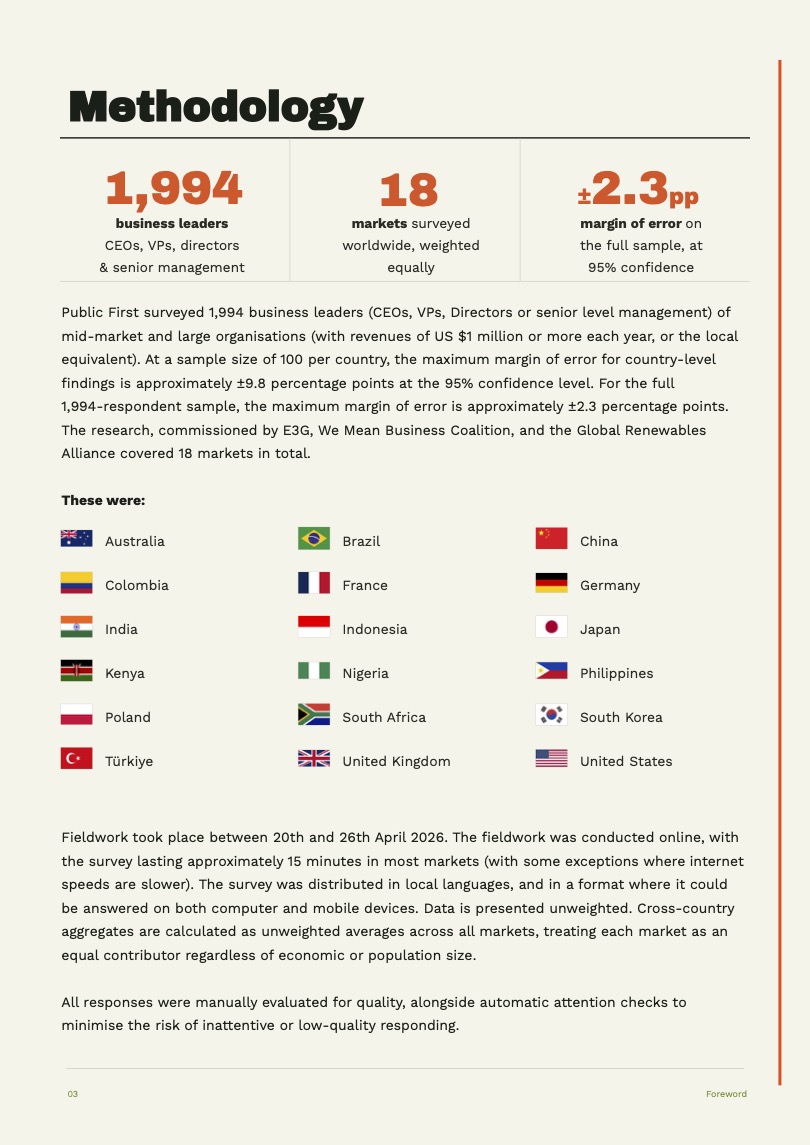
The survey polled 1,994 business leaders (CEOs, VPs, Directors or senior level management) across key economies and emerging markets from medium and large organisations (revenues of US $1 million or more each year, or the local equivalent).
Public First carried out the poll which was commissioned by E3G, We Mean Business Coalition and the Global Renewables Alliance. The fieldwork was conducted online from 20-26 April 2026.
Public First is a policy, research, opinion and strategy consultancy. We work with global companies, governments, start-ups, institutions and foundations around the world to tackle major public policy and strategic challenges.

About us
E3G is an independent climate change think tank with a global outlook. We work on the frontier of the climate landscape, tackling the barriers and advancing the solutions to a safe climate. Our goal is to translate climate politics, economics and policies into action.

We Mean Business Coalition is a global coalition of leading non-profit organizations and over 75 strategic and network partners, working with more than 23,000 businesses worldwide. The Coalition is made up of BSR, CDP, Ceres, Climate Group, Corporate Leaders Groups, The B Team and WBCSD. Together, we work with the world’s most influential businesses to drive action on climate and energy.

The Global Renewables Alliance (GRA) was established by the Global Wind Energy Council, Global Solar Council, International Hydropower Association, Green Hydrogen Organisation, Long-Duration Energy Storage Council and the International Geothermal Association to unify the global bodies representing the clean technologies required for a net zero world by 2050.
Contact Us
For media enquiries please contact: ppalmer@wmbcoalition.org.
Details for media are in the press release.